
Written by David Pearson, Estate President
We are very excited to share all the latest news on what is going on at Joseph Phelps in our vineyards!
For those of you who are reading our Borgo Blog for the first time; a brief recap. At Joseph Phelps, we have committed ourselves to adopting not just a different way of farming our vineyards, but an entirely new philosophy: agroecology, which asks us to change our very relationship with nature. Traditional farming starts with the belief that we are capable of manipulating and controlling nature to make it do what we want. Agriculture, as commonly practiced, creates large parcels of single crops, creating ‘monocultures’. With this farming approach; fertilizers, herbicides and insecticides are often necessary – effectively fighting against nature. Agroecology calls for us to bring back to our farming the full biodiversity of nature – in the soil and on the surface – allowing the natural eco-cycle to thrive. In doing so, we farm with a diversity of plants, bushes and trees creating ‘polycultures’ which produce crops that are more healthy, productive and resistant to health pressures and climate variation. See our first Borgo Blog if you would like a more detailed discussion of our Borgo Project.
Our Borgo Blog aims to share the on-going steps of our journey in realizing the implementation of agroecology in our vineyards at Joseph Phelps. In this Spring Edition, we will dive into what we mean by a vineyard’s membrane, spine and vertebrae.
~~~~~
The very first step is to recognize that a vineyard, and all agriculture, is not a sum of many separate pieces and parts. The soil and its many constituents, the vines and plants with their roots and their foliage, the weather – sun, rain, wind – the geology all of these and more, are not independent of each other. They are not a vast number of separate variables. Instead, we can try to see the vineyard as one single unit. One vastly complex living thing that is inextricably bonded to nature. As are we. . .
Our job is to see the ecosystem as one living unit and to interact in synchrony with it. Our job as such is to bring nature’s biodiversity into the heart and soul of our vineyards. To achieve this we will create membranes, spines and vertebrae around and within our vineyards.
What is a Membrane?
In our use of the term, a membrane is the perimeter of any given vineyard parcel. It is a bio-barrier full of selected trees, bushes and shrubs which encircle the vineyard. As with living beings, membranes provide protection from harmful agents while permitting beneficial elements to pass through. This is the role that our membrane will play with our vineyards.
What is a Spine?
In our vernacular, a spine is a row of selected trees, bushes and shrubs that will run right through the middle of our vineyards. While the membrane serves the purpose of providing protection to the vineyard, the Spine brings the biodiversity in full strength right into the middle of our vineyards. Depending on the size of the vineyard parcel we are working with, a parcel may have one or two spines – not quite the human metaphor with two spines, but the term still works.
What are Vertebrae?
The final step to bringing full biodiversity into our vineyards is to bring that diversity into the rows of vines themselves. To insert biodiversity into our formally ‘monocultured’ vineyards, we will plant fruit and soft-wood trees within the rows of the vines. For example, every third vine row will have a tree inserted between every third and fourth vine.
With the membrane, spines and vertebrae we will have introduced diversity and unlocked in our soils and on the surface nature’s full complexity and beauty.
Getting into the Soil
We planted our first membrane and spine this past February. In preparation we selected the many trees, bushes and shrubs: 51 species and 38 unique genera with 99.5% of them indigenous to our region. Trees for the membrane include the Big Leaf Maple, Madrone, Buckeye, Red Elderberry and Cedar. The Spine will have amongst many others Wild Lilac, Golden Current, and Manzanita, White and Purple Sage. The Vertebrae will be filled with fruiting trees including Apricot, Cherry, Peach and Quince.
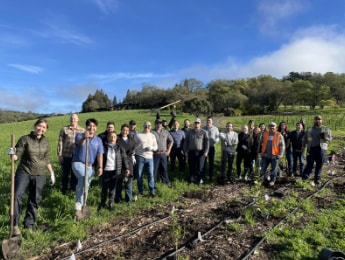
Once all of the plants and the soils were ready, our vineyard team, along with our consultants (Alain Canet and Daphne Amory) began planting with great precision our first membranes and spines. Each tree, bush and shrub had its specific location mapped out. We held back the south corner of our vineyard’s membrane so that the Joseph Phelps staff could get in on the action. Under beautiful blue skies, we got our hands into the very rich dark soil, and we planted trees, bushes and shrubs that will be there for many, many years into the future. We shared an exhilaration and joy in the process of achieving this first step in our journey together.
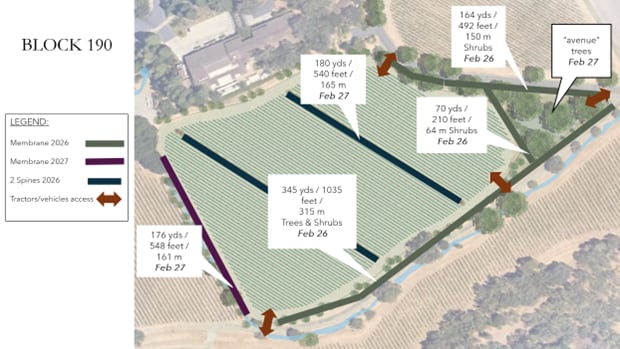
The image below shows the overall layout of one of our vineyard parcels with the membrane, spines and vertebrae. The membranes will grow for one year, allowing their root structures to fully establish deeply in the soil. Next year, at about the same time of year, we will come back to the vineyard and plant our spines and vertebrae – vine rootstocks and fruit trees. But that will be the subject of a future blog.
Why and how will this help?
The key to living soil is a plethora of bacteria and fungi. Roots eat bacteria, absorb the many nutrients they need, and exude compounds that support the bacteria. A truly virtuous cycle. We basically do the same thing when we eat… The more bacteria, the healthier the plant. The healthier the plant, the more vigorous and productive. Without bacteria in the soil, farmers are obliged to turn to fertilizers and chemicals. Fungi are also essential to healthy soil. Fungi close the eco-cycles of life in the soil, decomposing dead organic material and producing fresh new soil! Think of a beautiful fallen pine tree in the forest alive with bacteria and fungi, slowly giving back to the earth its nutrients in the form of fresh new soil. In addition, fungi produce a compound called Glomalin which causes soil to clump. Clumping soil retains more water… So, healthy bacteria-rich and fungi-filled soil retains 10 times the amount of water that which ‘non-healthy’ dirt retains. On the surface, with the broad range of fruiting and soft wood trees, birds and bats will flourish. They will naturally keep the insect population in proper balance, while providing much needed shade to our vines in the hottest summers. Nature thrives when just given the chance!
We will let our young trees, bushes and shrubs grow through the course of this summer. When you come to visit Joseph Phelps, we will be very happy to walk out with you to our vineyards to check out our little babies… see how well they are growing. You too can get your hands into the fresh moist soil. You will feel good! You’ll see… And we are already preparing for this coming fall’s next step: the planting of the vine rootstocks and fruit trees.
Next time: Mushrooms and mycelium: nature’s internet in the soil
On our next blog, we will drill down deeper into the soil to get a better understanding of mushrooms: Fungus in general and mycelium in specific. Mycelium is the delicate fibrous material that is the part of the mushroom organism beneath the soil. It is so fine in its structure that, on a healthy forest floor, beneath each footstep that you take is the equivalent of 500 miles of this fibrous material. Interest in mushrooms and their role in nature is exploding all around the world… like mushrooms. We are only beginning to understand the complex interactions that plants and animals have with mushrooms. A topic for digestion in our next Blog. Stay tuned.
Good reads and podcasts?

An Immense World – Ed Yong There are very few books better to read if you want to have an initiation to the vast complexity and intricacy of nature. A world that is unseen by humans but one that is essential that we understand and protect. You will be introduced to the term Umwelt… Vigorous research is coupled with great story telling.
And, if you want to get ahead of the class…, listen to John Kempf’s podcast, Regenerative Agriculture Podcast, Episode 99 with Dr. James White. You will be ready for our next blog.