by David Pearson, Joseph Phelps President
This is third offering of our Borgo Blog that follows and shares the details behind the implementation of agroecology in our vineyards. This Summer Blog will focus on one of our favorite topics… mushrooms. Mushrooms, fungus, lichen, molds… the little-known but unbelievably complex world of fungi.
But first, let’s bring you up to date with what is going on in our vineyards. In our previous blog, we explained how we see our vineyards as single living entities. If you missed that blog, go back and check it out so you can understand what we mean by membranes, spines and vertebrae in our vineyards. Our goal is to bring the full range of nature’s biodiversity into our vineyards, in the soil and on the surface. The first step is to create a vibrant living soil full of bacteria, microbes and… the focus of this blog… fungus. We will bring this biodiversity to our vineyards by planting a large selection of trees, bushes and shrubs around and within our vines.
In February of this year, we planted a selection of native trees – maples, madrone, ash, dogwood, and many more – around the perimeter of our vineyard – our membrane. Bushes and shrubs were included to create broad diversity. This coming winter we will plant our vine rootstocks – a selection of American vine varietals that are resistant to the root louse, Phylloxera. And we will plant a selection of trees – cherry, apple, pear, apricot, peach, and more – in the middle of our vine rows.
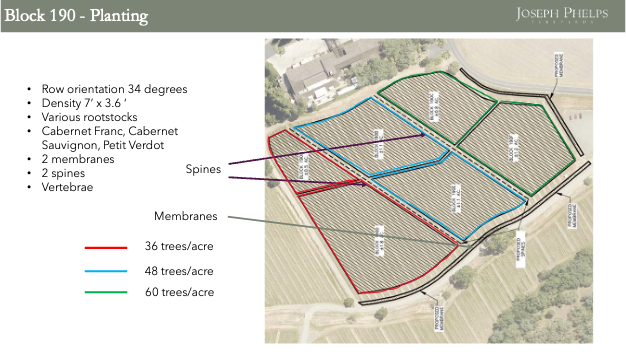
The image above shows our planting plan. Every aspect of the parcel has been considered: row orientation, vine density, and varietal selection. You can see that we have divided the vineyard into six sub-parcels, because the soil is different in each sub-parcel. In this vineyard we will be testing the impact on the vines of the density of trees (number of trees per acre). We are testing three different densities: 36, 48 and 60 trees per acre. Why test this? Because this has never been done before in Napa Valley. No one knows precisely what is the optimal number of trees that should be planted within a vineyard. We will learn from our experience in this vineyard.
Come visit us in the early months of 2027 and let us show you our newly planted vineyard. If you come at the right time, you may be able to plant a tree yourself.
But… how does the subject of fungus matter here? Why should we focus on mushrooms in a vineyard?
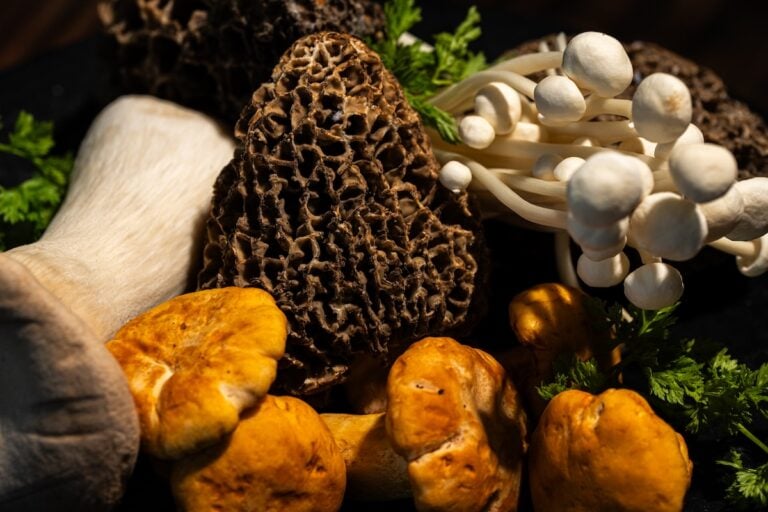
Everyone knows something about mushrooms, but in fact we know so little.
All of us know about mushrooms. Many of us picture a classic image of a mushroom with a big red cap. Many others think of edible mushrooms such as morels, chanterelles or truffles. Most have heard of – some have tried – hallucinatory mushrooms. And hopefully everyone knows that many mushrooms are very toxic and can make you sick or dead.
But very few people know that the range and scope of fungi species is astounding. We literally do not know how many exist. Checking the resources one finds that there are today between 100,000 to 150,000 unique fungi species. These are only those that have been identified so far. Some studies suggest that the ultimate number of species may be 2 million or more. As interest in fungi and mushrooms has exploded recently, more are being identified each day. Note that not all fungi are mushrooms… There are at least 25,000 unique mushrooms, and maybe ultimately as many as 140,000 or more.
The mushroom is the ‘fruiting body’ of the larger organism. What lies beneath the soil is every bit as important as what we see on the surface. Beneath the surface of a mushroom is the ‘mycelium’. This is the fibrous and delicate feeding network of the mushroom. In a healthy forest beneath each footprint, under each step, is the equivalent of 500 miles of the fine mycelial network. This lace-like structure can grow to immense sizes. The largest living organism on the planet is thought to be a mushroom in Oregon, the Humongous Fungus (Armillaria ostoyae), a massive honey mushroom network. It spans 2,385 acres (nearly 4 square miles) in the Malheur National Forest in eastern Oregon. It weighs 35,000 pounds. It is also believed to be the oldest living organism on the planet. Scientists estimate that it may be between 2,000 and 8,500 years old!
The presence and function of mycelium is essential to healthy soil – and too complex to fully cover in this blog. Suffice it to say that research has shown that agricultural produce varies in quality and in quantity depending on the specific mycelium in a given soil. In our wine world, we speak of ‘terroir’ which is the unique quality of grapes produced from any given location and soil. We now understand that the presence or absence of mycelium can affect our terroir, and as such, affect the quality of our wines.
Fascinatingly, it has been shown that trees will use the mycelium to ‘communicate’ with each other and to send nutrients to trees in need. How this happens and the extent of the exchanges and interactions are being studied presently. The more that we learn, the more that we understand that fungi and mycelium are fundamental to a healthy ecosystem.
And perhaps most importantly, fungus and mushrooms are nature’s own recyclers. They close the loop in nature’s cycle of life. Fungi break down organic material and render it into bioavailable components. Under a pile of decomposing straws and grasses you will find a thin layer of new soil thanks to our mushroom friends! They take dead trees, plants and animals and literally make new soil and new life possible.
Glomalin and the clumping of soil – water retention
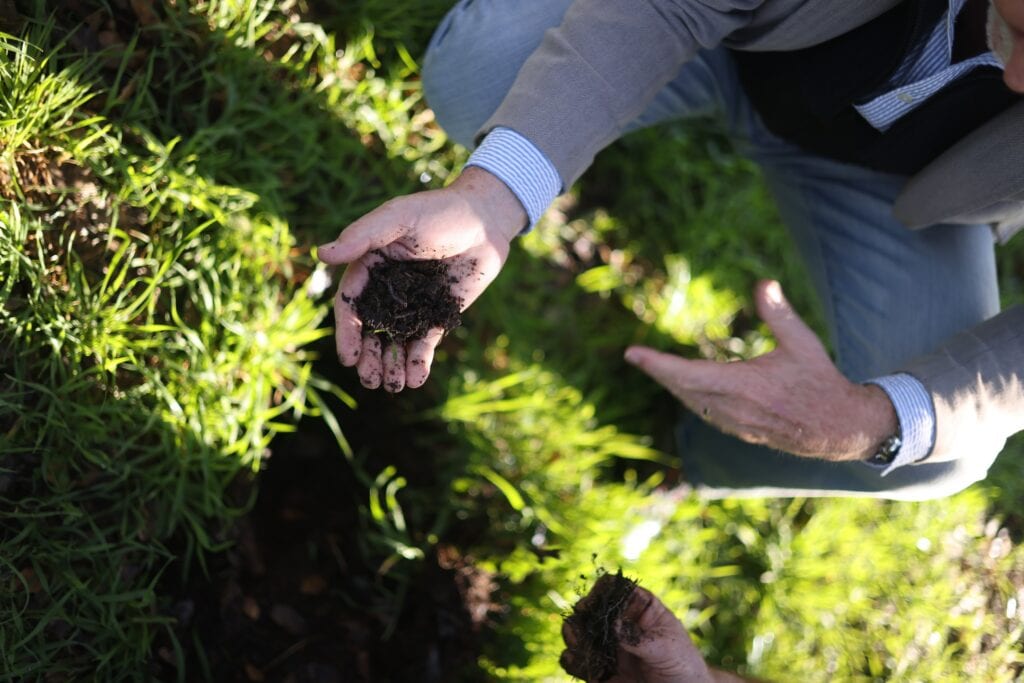
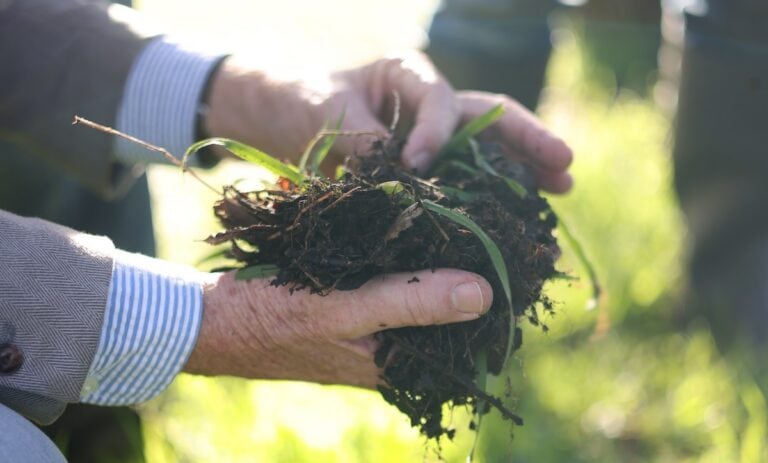
It is all about the clumping. Healthy living soil is moist, and it clumps in your hands. Lifeless soil is really just dirt. Dirt crumbles and falls between your fingers with a puff of dust flying away.
Mycelium exudes a component called ‘glomalin’. Here’s where it comes from. Our vines capture CO2 to produce sugars. 30% of the sugars is sent to the roots which feed the fungi in the soil, which spreads the mycelium throughout the soil. With the growth and death of the mycelium, glomalin accumulates in the soil. In exchange for this, the fungi provide the vine with essential minerals – phosphorus, zinc and copper, among others.
The glomalin makes the soil clump. The clumping of the soil makes it more absorbent for water, which is why healthy soil is moist! Glomalin-rich soil can hold 10 to 20 times as much water as can dry dirt.
The glomalin also stimulates carbon sequestration, general nutrient retention and increased overall biodiversity – bacteria, earthworms, microbes and insects. One teaspoon of healthy soil… contains more living organisms than there are people on the planet!
The complexity of fungi and mushrooms is astounding, and we have only started to fully understand and appreciate the critical role that they play in keeping our soil healthy.
Foraging for mushrooms – come join us
The world of mushrooms is wonderful not only because they protect our soils, but also because some of them are delicious and healthy for us to eat! And while you can find a great variety of mushrooms at your local fine grocery, the act of searching for your own mushrooms… foraging for mushrooms has so many benefits. The process of roaming with purpose through the woods while at the same time losing yourself amidst the plants and trees is one of the most calming and healthy activities that you can do. Many of us have forgotten how to engage with forests. They invite us to slow down and breathe more deeply. Foraging for mushrooms can help us not only reconnect with nature, but also with ourselves.
Dr. Gordon Walker (Dr. Fun Guy) has excellent advice for foraging. He lists these general rules:
- Avoid eating all mushrooms with gills
- White gilled mushrooms are deadly poisonous.
- Mushrooms growing in grass are safe to eat.
- Boletes that stain blue are poisonous.
- Do not eat boletes with red pores.
- If animals are eating a mushroom, then it is safe for you to eat.
- If it’s small and brown, throw it down.
- All polypore’s that grow on wood are safe to eat.
Gordon quickly adds, “while these rules may be a good starting point for beginner foragers, all of these common saying have exceptions or are just plain incorrect…” Be sure to forage with experts. And only taste mushrooms after a pharmacy or expert have identified the species.
We invite you to join us several times a year as Gordon (Dr. Fun Guy) leads our foraging efforts on the Joseph Phelps Home Ranch.
So mushrooms are indeed an essential element to our work in bringing nature’s full biodiversity to our vineyards. And we are just at the beginning of learning how fungi interact with the plants, trees and soils to make them – and us – healthy and alive.
Stay tuned. We are just getting started. There’s much more to come!
Books
To begin your own journey in learning more about fungi and mushrooms, you really must start with these books:
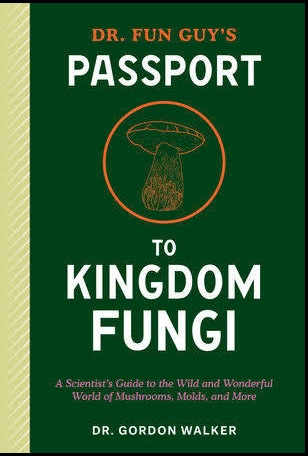
Dr. Fun Guy’s Passport to Kingdom Fungi, by Dr. Gordon Walker.
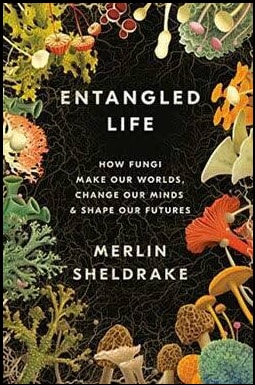
The Entangled Life, by Merlin Sheldrake
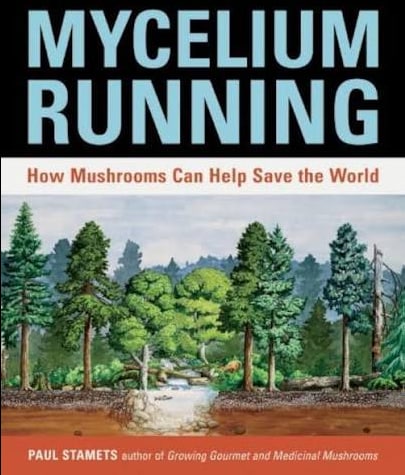
Mycelium Running – How Mushrooms Can Help Save the World, by Paul Stamets